What does the future hold for patient enrollment?
This is just one lesson we learned!
Download the full eBook to explore all the insights we gained from surveying hundreds of site staff and clinical researchers about the state of enrollment in 2026 and beyond.
AI is no longer optional when it comes to patient enrollment
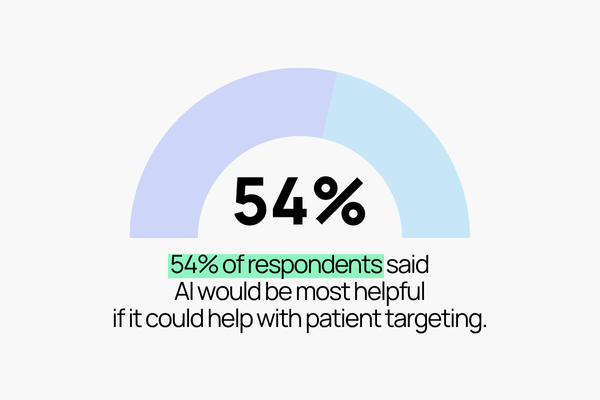
Sponsors have invested heavily in AI-driven approaches to patient recruitment over the past several years, and site feedback suggests that momentum will continue. Fifty-four percent of site staff agree that AI will play a large role in their work in 2026 and beyond, signaling that AI is moving from experimental to expected in day-to-day enrollment operations.
For sites, the value of AI lies in its ability to reduce manual effort and improve speed and accuracy across routine tasks. From identifying eligible patients to prioritizing outreach and supporting faster decision-making, AI is increasingly viewed as a practical tool rather than a novelty.
As adoption grows, the differentiator will not be whether AI is present, but how well it is embedded into workflows in ways that are transparent, trustworthy, and easy for site teams to use.
Where technology actually accelerates enrollment
Looking ahead to 2026, site teams expect enrollment performance to be influenced by two opposing forces: more sophisticated patient acquisition and tighter operational constraints.
On the opportunity side, 54% of sites point to AI-driven patient targeting as the greatest potential upside, signaling strong optimism that smarter identification and prioritization of patients can improve speed and efficiency.
At the same time, execution is becoming less forgiving. Forty percent of sites cite budget pressure as a growing constraint, raising expectations for precision, efficiency, and clarity across every stage of enrollment. In response, site teams are asking for practical improvements that help them operate within these limits, including more flexible visit options (40%), stronger patient communication (32%), and clearer enrollment goals and expectations (32%).
Enrollment success will depend on pairing advanced targeting capabilities with simpler, site-friendly operations. Sponsors who combine AI-powered acquisition with streamlined workflows, flexible study design, and clear execution guidance will achieve faster, more predictable enrollment outcomes.
Download Now: The State of Enrollment (2026)
No assumptions. No recycled benchmarks. Just an unfiltered look at what’s working, what’s broken, and what study teams need to rethink to enroll with confidence in 2026.
Download the full report to explore all the insights we gained from surveying hundreds of site staff and clinical researchers.
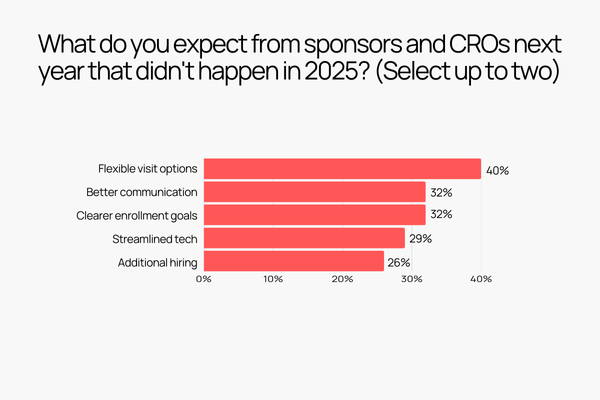
What do you expect from sponsors and CROs next year that didn't happen in 2025?
Site teams are entering the next year with clear expectations for how sponsors and CROs need to show up differently. At the top of the list is flexible visit options, cited by 40% of respondents, reflecting growing pressure to accommodate patient needs, site capacity, and operational constraints. Rigid visit structures are increasingly seen as a liability, especially as studies compete for both patients and site resources.
Communication and clarity are close behind. 32% percent of site staff expect better communication, and an equal 32% want clearer enrollment goals than what they experienced in 2025. These responses point to a need for tighter alignment early in the study, including realistic expectations, consistent messaging, and fewer last-minute changes that disrupt site workflows and patient engagement.
Why this matters for patient recruitment and study enrollment
When sponsor and CRO expectations do not align with site realities, enrollment slows and operational strain increases. Rigid visit structures, unclear goals, and inconsistent communication create friction that sites must absorb, often at the expense of speed and patient experience. Addressing these gaps is not about incremental improvement. It is about removing the obstacles that prevent sites from executing efficiently from day one.
As budgets tighten and studies grow more complex, success will depend on making enrollment easier to run, not harder to manage. Flexible visit options, clear targets, and streamlined technology allow sites to focus on patients rather than workarounds. Sponsors and CROs that respond to these signals will see faster timelines, stronger site engagement, and more predictable enrollment outcomes.