Technology fatigue is setting in with site staff.
This is just one lesson we learned!
Download the full eBook to explore all the insights we gained from surveying hundreds of site staff and clinical researchers about the state of enrollment in 2026 and beyond.
The enrollment problem isn't a technology gap
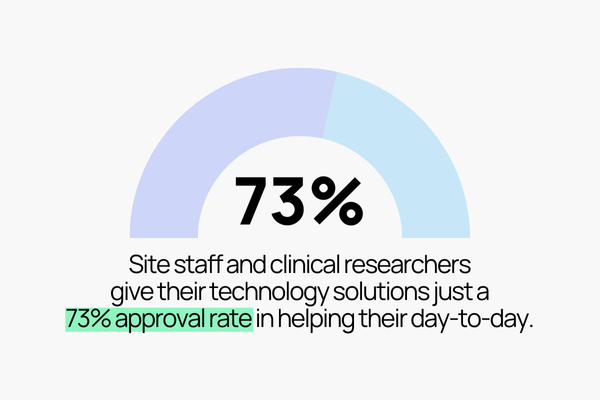
Sponsors often look to new technology as the primary solution to enrollment challenges. However, site feedback suggests the issue is less about lacking tools and more about how existing ones are used. Sites give their current enrollment solutions a 73% approval rating, indicating that most teams already have capable technology in place.
The bigger opportunity lies in simplifying and aligning workflows. Adding more tools can increase complexity, training burden, and fragmentation across systems. In contrast, streamlining processes, reducing handoffs, and making better use of existing technology enables sites to work more efficiently and focus their time on patient engagement rather than system navigation.
Enrollment gains are most likely to come from operational clarity and execution, not constant platform expansion. When workflows are intuitive and integrated, sites move faster, patients experience less friction, and enrollment performance improves without introducing additional overhead.
Where technology actually accelerates enrollment
Site teams are providing a clear roadmap for how technology can meaningfully speed enrollment in 2026. Rather than asking for more tools, they are asking for targeted automation in the moments that create the most friction. The strongest signal is pre-screening, where 48% of sites want automation to reduce manual work and early drop-off. Additional priorities include document collection (32%) and patient outreach (32%), areas where repetitive tasks slow teams down and delay progress.
Beyond automation, sites emphasize the need for better-connected platforms that reduce swivel-chair work. Forty percent of respondents cite improved integrations as a top requirement, enabling staff to move seamlessly between systems without duplicating effort. Real-time eligibility review (32%) is another critical capability, allowing sites to quickly assess patient fit and maintain momentum.
Together, these priorities point to a clear conclusion: enrollment accelerates when technology simplifies workflows, connects systems, and removes friction at the earliest stages of the patient journey.
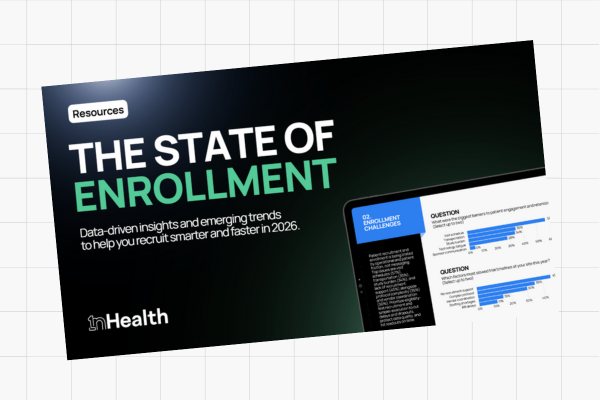
Download Now: The State of Enrollment (2026)
No assumptions. No recycled benchmarks. Just an unfiltered look at what’s working, what’s broken, and what study teams need to rethink to enroll with confidence in 2026.
Download the full report to explore all the insights we gained from surveying hundreds of site staff and clinical researchers.
Where in the process do you see the most patient drop off?
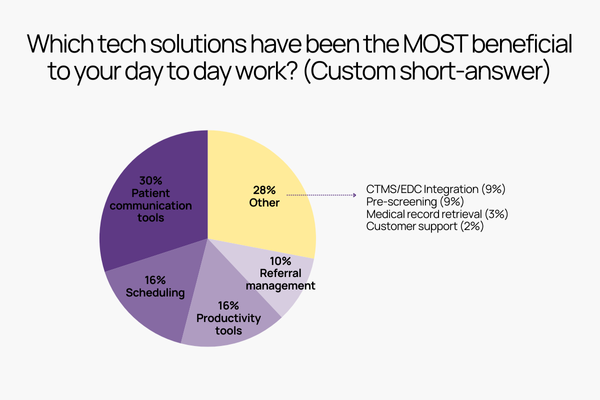
Site staff consistently value technology that makes their daily work easier, not tools built around flashy or rarely used features. When asked which solutions are most beneficial, responses clustered around capabilities that directly reduce operational friction. Patient communication leads the list at 30%, followed by scheduling and reminders (16%) and simple productivity tools (16%), all of which help teams move patients through the enrollment process more efficiently.
Secondary priorities such as referral and lead management (11%) reinforce the same theme: value is created where tools support execution, not complexity. The takeaway is clear. Investments deliver the greatest return when they target workflow moments that remove bottlenecks, minimize manual effort, and help site teams move patients forward faster.
Why this matters for patient recruitment and study enrollment
When technology investments fail to address day-to-day friction, they add complexity without improving enrollment outcomes. Site teams spend the majority of their time on patient-facing and operational tasks, so tools that do not directly support communication, scheduling, and follow-up often go underused. Prioritizing features that streamline these moments helps reduce staff burden and keeps patients moving through the enrollment process.
Focusing investment on practical, high-impact workflows allows sites to work faster without sacrificing quality or experience. When communication is easier, scheduling is simpler, and productivity tools remove manual steps, teams can maintain momentum from first contact to enrollment. The result is fewer delays, lower drop-off, and more predictable enrollment timelines.