Automation isn't enough to engage patients.
This is just one lesson we learned!
Download the full eBook to explore all the insights we gained from surveying hundreds of site staff and clinical researchers about the state of enrollment in 2026 and beyond.
Why automation falls short when it comes to patient recruitment
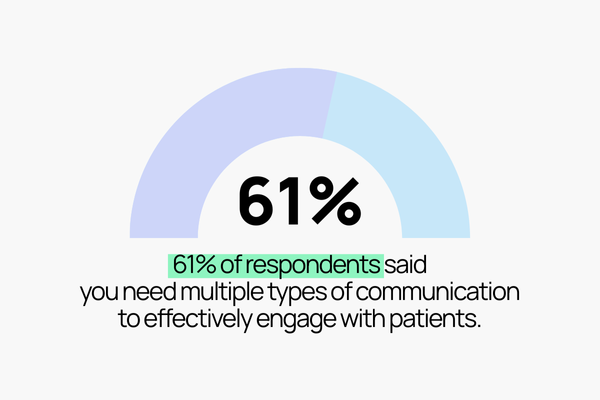
Sponsors often look to automation as the primary lever for scaling patient outreach. While automation can increase reach and efficiency, site staff report that it is not sufficient on its own. According to our research, nearly two-thirds of site respondents agree that engaging patients effectively requires multiple types of communication, not a single automated channel.
Patients respond differently depending on the message, timing, and medium. Relying exclusively on automated outreach can limit engagement, particularly for studies that require trust, education, or repeated follow-up. Sites consistently report better response rates when outreach combines automation with more personalized, human touchpoints across channels such as phone, text, email, and in-person conversations.
Effective patient engagement is not just about scale, but about relevance and flexibility. Programs that support multi-channel communication enable sites to meet patients where they are, improve responsiveness, and sustain engagement throughout the enrollment process.
Enrollment success lives in the follow-up
Enrollment rarely hinges on a single click or initial outreach. It is won through consistent, thoughtful follow-up that builds trust and removes friction. Site feedback reinforces this reality: 80% of sites cite phone calls as the most effective way to engage patients, while 52% point to SMS as a critical channel for timely communication.
The most effective enrollment workflows are intentionally multi-modal. Phone calls allow site staff to answer questions, address concerns, and build confidence. SMS supports quick reminders and confirmations that keep patients moving forward. Email provides space for detailed information patients can review on their own time. When these channels work together, sites are better equipped to meet patients where they are and respond in the moments that matter most.
This approach reduces missed connections, shortens scheduling cycles, and helps prevent drop-off between interest and enrollment. By prioritizing follow-up over initial clicks, studies can convert more interested patients into enrolled participants and maintain momentum throughout the recruitment process.
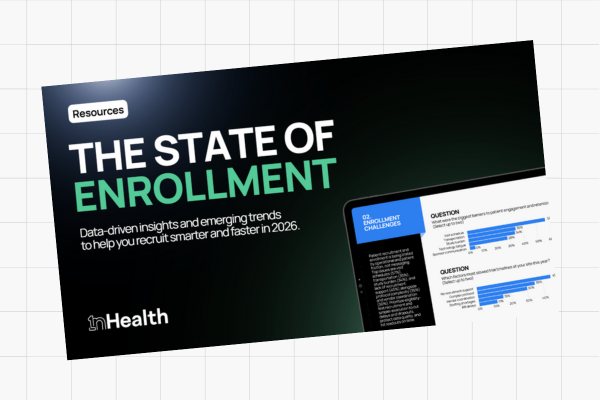
Download Now: The State of Enrollment (2026)
No assumptions. No recycled benchmarks. Just an unfiltered look at what’s working, what’s broken, and what study teams need to rethink to enroll with confidence in 2026.
Download the full report to explore all the insights we gained from surveying hundreds of site staff and clinical researchers.
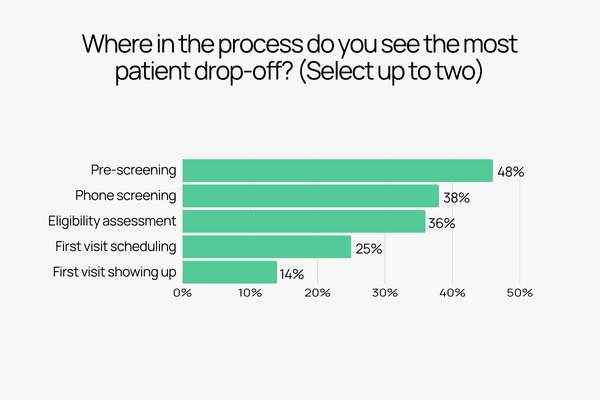
Where in the process do you see the most patient drop off?
Patient drop-off happens earliest in the enrollment process. Nearly half of sites (48%) report the greatest drop-off during pre-screening, making it the most common point of attrition. Additional losses occur during phone screening (38%) and eligibility assessment (36%), underscoring how quickly interest can fade when follow-up is slow or requirements are unclear.
Later stages see less drop-off but still contribute to enrollment delays. 25% of sites report drop-off during first visit scheduling, while 14% see losses when patients fail to show up for their first visit. These findings highlight that enrollment success depends on reducing friction and maintaining momentum across early interactions, not just generating initial interest.
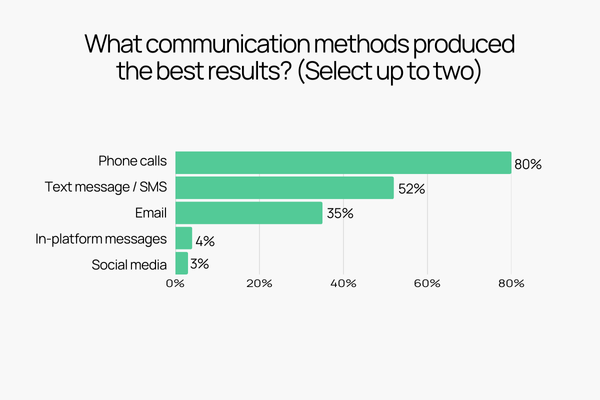
What communication methods produced the best results?
Direct, personal communication consistently delivers the strongest enrollment results. 80% of sites report phone calls as the most effective outreach method, reinforcing the importance of real-time conversations to answer questions, build trust, and move patients forward. Text messaging follows at 52%, reflecting its value for quick follow-ups, reminders, and confirmations that keep patients engaged.
Email continues to play a supporting role, with 35% of sites citing it as effective, particularly for sharing detailed information patients can review on their own time. In contrast, in-platform messages (4%) and social media (3%) show minimal impact, highlighting that enrollment success depends less on passive digital touchpoints and more on timely, multi-channel communication that meets patients where they are.
Why this matters for patient recruitment and study enrollment
When communication strategies are misaligned with how patients actually respond, enrollment slows and drop-off increases. Over-reliance on low-engagement channels can leave interested patients waiting for answers, uncertain about next steps, or disengaged altogether. The data makes it clear that timely, direct communication is critical to maintaining momentum through the enrollment funnel.
By prioritizing high-impact channels like phone and SMS, sites can resolve questions faster, reduce missed connections, and move patients from interest to enrollment more efficiently. A multi-channel approach ensures that outreach is not only scalable, but effective, helping studies shorten timelines, improve show rates, and ultimately enroll more patients.